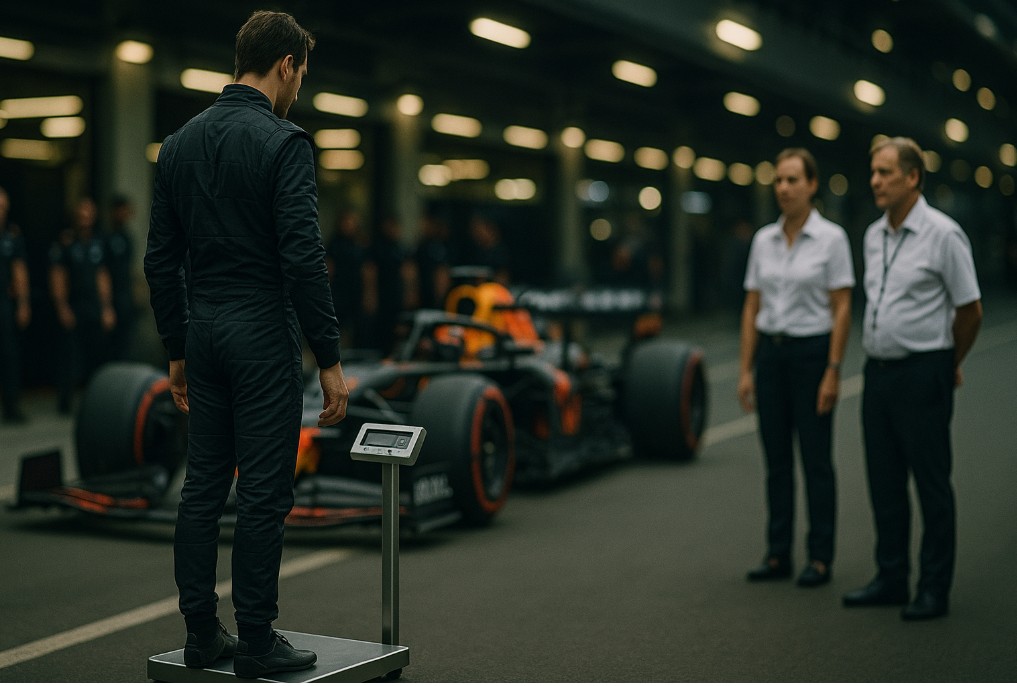
Why Do F1 Drivers Get Weighed?

Have you ever wondered why Formula 1 drivers, after an exhausting race, are immediately directed to a set of scales instead of heading to celebrate with their teams? Why is weighing drivers such a crucial part of the post-race process? And what role does it play in both fairness and safety?
The truth is that driver weight is one of the most finely regulated aspects of Formula 1. It is not simply about checking numbers on a scale, but about ensuring compliance with FIA rules, maintaining driver health, and safeguarding the integrity of the sport.
Why Are F1 Drivers Weighed After Every Race?
Formula 1 drivers are weighed after every race to make sure that they, along with their cars, meet the strict minimum weight regulations set by the FIA.
The rules exist to keep the competition fair and to prevent teams from gaining an advantage by fielding dangerously light cars or relying on drivers with extreme body weights.
During a Grand Prix, drivers can lose several kilograms of body weight due to dehydration and sweat. Because of this, their post-race weigh-in helps confirm that the combined weight of the driver and the car remains within the limits.
Without this check, some competitors might slip below the required standard, which could not only give them an unfair edge but also compromise safety.
How Does Weighing Drivers Ensure Fair Competition?

In a sport where milliseconds make the difference between victory and defeat, weight plays a huge role in performance.
Before 2019, smaller drivers often had a significant advantage because lighter body weight gave their teams more freedom to distribute ballast across the car, improving handling and balance.
Taller and heavier drivers, by contrast, were at a disadvantage since their body weight reduced this flexibility.
To counter this, the FIA introduced a rule requiring all drivers, in full race gear, to weigh at least 80 kilograms. If a driver falls short of this mark naturally, ballast must be added to meet the standard.
This approach ensures that no competitor benefits simply from being lighter, making the competition about talent, engineering, and strategy rather than natural body type.
How Does Driver Weight Affect Health and Recovery?
The importance of post-race weighing extends beyond the regulations it also plays a significant role in monitoring driver health.
Racing in a cockpit that can reach temperatures over 50°C (122°F), drivers often lose between 2 to 4 kilograms during a race, almost entirely through fluid loss.
By recording their weight immediately after the race, teams and physiotherapists can quickly assess how much fluid has been lost.
This information guides their recovery process, helping them rehydrate effectively and prepare for the next session. Without this monitoring, drivers could be at risk of fatigue, reduced concentration, or longer-term health issues.
What Role Does the Minimum Weight Requirement Play?
The minimum weight requirement of 80 kilograms, including helmet, race suit, gloves, and boots, is one of the most important regulations in Formula 1.
It levels the playing field between drivers of different body sizes and ensures that nobody races at a dangerously low body weight simply to gain a performance advantage.
For example, a naturally lighter driver might weigh 70 kilograms with gear. In that case, their team must add an additional 10 kilograms of ballast to meet the threshold.
This requirement prevents the sport from rewarding drivers who might otherwise resort to unhealthy weight loss methods to compete.
How Do Teams Use Ballast in Formula 1?

Ballast is not just a regulatory necessity it is also a strategic tool. When teams add ballast to make up for a driver’s weight deficit, they can choose where to position it on the car. Placement affects how the car handles corners, accelerates, and brakes.
For instance, adding ballast near the front can improve steering and corner entry, while positioning it at the rear can enhance traction out of corners. Teams spend countless hours fine-tuning these details to maximize performance.
However, the FIA’s strict post-race checks ensure that the system is used fairly, rather than as a loophole to gain illegal advantages.
What Happens During the Weigh-In Process?
The weigh-in process is carefully managed to prevent tampering or inaccuracies. Immediately after finishing a race, drivers exit their cars and head directly to the scales.
They are weighed in full gear, including helmets and race suits, before they have the chance to rehydrate or change.
This procedure is part of the broader system known as scrutineering, where FIA officials inspect both the car and the driver to verify compliance with all regulations.
By combining these checks, the FIA ensures fairness and prevents any manipulation of results through last-minute adjustments.
What Happens If a Driver Fails the Weigh-In?

Failing the weigh-in carries serious consequences. If a driver and their car do not meet the minimum combined weight, they risk losing their result from the race.
Penalties can include disqualification, which has happened in past seasons when teams were found to have breached weight regulations.
This strict enforcement emphasizes how important weight is in Formula 1. It is not treated as a minor technicality but as a central part of the sport’s fairness and safety standards.
Do Other Motorsports Weigh Drivers Too?
Formula 1 is not alone in considering weight, but it does enforce the rules more stringently than most other series.
Here is a comparison:
| Motorsport | Driver Weighed? | Minimum Driver Weight Rule | Focus of Regulations |
|---|---|---|---|
| Formula 1 | Yes | 80 kg (with gear) | Fairness & safety |
| IndyCar | Yes | No fixed driver minimum | Overall car weight |
| NASCAR | Rarely | No fixed driver minimum | Total car balance |
| MotoGP | No | N/A | Rider fitness & safety |
This comparison shows that Formula 1 stands out for regulating both car and driver weight together, making it one of the strictest forms of motorsport when it comes to balance and compliance.
Why Is Weighing Drivers So Important in F1?
Ultimately, weighing drivers after races serves multiple purposes. It enforces fairness by ensuring no team benefits from having a naturally lighter driver, it protects athletes by tracking hydration and recovery needs, and it upholds safety by preventing dangerously light cars from entering competition.
Formula 1 is a sport of precision, where every kilogram matters. The weigh-in process may appear routine, but it reflects the fine balance between human endurance, engineering mastery, and strict regulation. Without it, the integrity of the sport would be at risk.
FAQs
Do F1 drivers lose weight during a race?
Yes, drivers often lose 2 – 4 kilograms during a race due to sweating and dehydration in the extreme cockpit heat.
Why are F1 drivers weighed in full gear?
They are weighed with helmets, suits, gloves, and boots because the FIA minimum of 80 kilograms includes all race equipment.
How does ballast help level the playing field?
Ballast is used to make up for lighter drivers and can be positioned strategically to adjust car handling, ensuring fairness in competition.
What is scrutineering in Formula 1?
Scrutineering is the FIA’s inspection process, where both the car and driver are checked post-race to ensure compliance with all regulations.
Has a driver ever been disqualified for being underweight?
Yes, disqualification has occurred in cases where cars and drivers failed to meet the FIA’s minimum weight requirements.
Do taller drivers face disadvantages in F1?
Taller drivers weigh more and therefore have less flexibility with ballast placement, but the 80 kg minimum reduces this imbalance.
Why does hydration matter so much for drivers?
Because significant weight loss from fluid depletion can impair performance, rehydration is vital for recovery and long-term health.